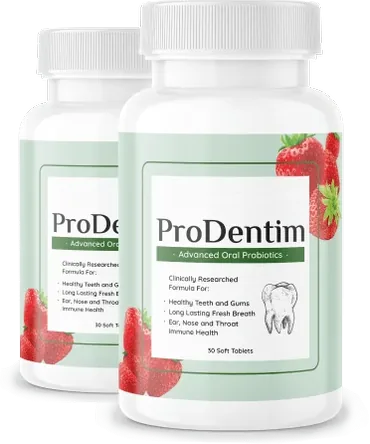
ProDentim vs ProvaDent, DentiCore, Dentitox Pro and PowerBite: Which Oral Supplement Fits Your Goal?
Several supplements compete for the same buyers, each built on a different idea. This comparison explains what each approach does for you, so you choose by goal rather than by advert, and shows where ProDentim's probiotic-first design is the stronger fit.
Key takeaways
- ProDentim is a five-strain oral probiotic in chewable form; its closest rivals by approach are ProvaDent and PurDentix.
- DentiCore and PowerBite are mineral and herbal chewables without a probiotic focus; Dentitox Pro is a liquid vitamin and herb drop.
- For fresher breath and calmer gums, the probiotic approach has the most relevant clinical research.
- None of the branded products has a published trial of its finished formula; pharmacy lozenges offer named strains at a lower price with fewer strains.
How we compared. Details of competing products come from each brand's own published materials at the time of writing. Formulas and prices change, so check current labels. We have not laboratory-tested any of them, and we earn a commission only on ProDentim.
Quick comparison
| Product | Form | Core approach | Probiotics? |
|---|---|---|---|
| ProDentim | Soft chewable tablet | Five-strain oral probiotic plus prebiotic and minerals | Yes, 3.5 billion CFU |
| ProvaDent | Capsule | Oral probiotic strains with cranberry and xylitol | Yes |
| PurDentix | Chewable tablet | Oral probiotic blend similar in concept to ProDentim | Yes |
| DentiCore | Chewable tablet | Minerals and plant extracts aimed at gum tissue | No |
| PowerBite | Chewable "mineral candy" | Calcium and herbal ingredients aimed at enamel | No |
| Dentitox Pro | Liquid drops | Vitamins, minerals and herbal extracts | No |
| Pharmacy oral probiotic lozenges | Lozenge | One or two named, researched strains | Yes |
ProDentim vs ProvaDent
Both are probiotic-based, which makes this the closest match-up.
What they share. Both aim to rebalance oral bacteria and both use Streptococcus salivarius strains from the BLIS family, studied for breath and plaque.
Where they differ. ProDentim is a chewable tablet, so its bacteria are released in the mouth where they act. ProvaDent is presented as a capsule, which raises the question of how its strains reach oral surfaces. ProvaDent adds cranberry extract and xylitol, both with research on bacterial adhesion; ProDentim adds Lactobacillus reuteri and Lactobacillus paracasei, the lactobacilli with the strongest gum-health evidence.
Choose ProDentim for the format used in oral-probiotic trials and the gum-focused lactobacilli. Consider ProvaDent if you specifically want cranberry and xylitol in one product.
ProDentim vs DentiCore
DentiCore takes a different path: its marketing centres on gum tissue and "oxygenation" with minerals and plant-derived ingredients rather than bacteria.
Evidence. The oral-probiotic concept behind ProDentim rests on a body of randomised trials at ingredient level; the mechanism DentiCore describes is less established in dental research.
Format. Both are chewables taken once a day.
Choose ProDentim for an approach grounded in microbiome research. Consider DentiCore if you have been advised to avoid probiotics and want a non-probiotic chewable, accepting the thinner evidence.
ProDentim vs Dentitox Pro
Dentitox Pro is a liquid applied to teeth and gums or added to toothpaste, built on vitamins (A, C, D3, K2), minerals and herbal extracts.
Evidence. Vitamins matter for oral health when you are deficient, particularly C and D. With an adequate diet, extra amounts applied as drops add little.
Experience. Drops are less convenient than a tablet, and taste reviews are mixed.
Choose ProDentim for a probiotic benefit and a ten-second routine. Consider Dentitox Pro if you prefer a topical liquid and are not looking for probiotics; a standard multivitamin covers the vitamin content more cheaply.
PowerBite vs ProDentim
PowerBite is sold as a "dental mineral candy": a chewable with calcium and herbal ingredients, marketed around enamel strength and sensitivity.
Overlap. Both are daily chewables and both contain a calcium source.
Difference. PowerBite has no probiotic component; its case rests on minerals and botanicals, while ProDentim's rests on live bacteria plus minerals.
Choose ProDentim for breath and gum support. Consider PowerBite if sensitivity is your main concern, although a desensitising fluoride toothpaste is the better-proven first step.
Is PurDentix the same as ProDentim?
No. PurDentix is a separate brand from a different seller. The confusion is understandable: it is also a chewable oral probiotic with a similar sales-page structure, and some affiliate sites have even pasted PurDentix text onto ProDentim pages by mistake. They are competitors with their own labels, prices and refund terms.
ProDentim vs ProDentim: watch for copies
Some "comparisons" you will see are between the genuine product and its imitators: "ProDentim capsules", "ProDentim Max" and similar marketplace listings. Our guides to ProDentim soft chews and to ProDentim knock off products show how to tell them apart.
Products like ProDentim from the pharmacy
If you want an oral probiotic with maximum label transparency, plainly labelled lozenges from established supplement brands are worth a look:
- Named strains. The L. reuteri strain pair used in many gum-health trials is sold as a dental lozenge, and S. salivarius K12 and M18 lozenges are widely available.
- Stated dose per strain, so you can compare with the research.
- Lower price, often $15 to $35 a month.
The trade-offs are fewer strains per product, no bundled prebiotic or minerals, and usually no extended money-back guarantee.
How to choose
- Decide on the mechanism. For breath and gums, probiotics have the most relevant evidence. For sensitivity and decay prevention, fluoride toothpaste outperforms every supplement.
- Check the form. For an oral probiotic, pick a lozenge or chewable over a capsule.
- Read the label. Named strains and stated CFU counts signal a confident manufacturer.
- Look at the refund terms. A 60-day guarantee reduces your risk.
- Compare cost per day, not per bottle.
Where ProDentim fits
ProDentim's strengths against this field are its delivery format, its combination of gum-focused lactobacilli and breath-focused S. salivarius strains in one tablet, its prebiotic and mineral support, and its 60-day guarantee. Its trade-offs are the proprietary blend and a price above pharmacy lozenges. For fresher breath and calmer gums with the least effort, it is the strongest pick among the direct-response brands; for the lowest price on a single strain, a pharmacy lozenge wins. Read the full ProDentim supplement guide, then check the ProDentim price bundles before you decide.
Frequently asked questions
What is better, ProDentim or ProvaDent?
Both are probiotic-based. ProDentim's chewable format and lactobacillus strains align more closely with the clinical research on gum health; ProvaDent adds cranberry and xylitol. Neither has a published trial on its finished formula.
Is DentiCore better than ProDentim?
They work on different principles. ProDentim's probiotic approach has more supporting research at ingredient level than DentiCore's mineral and plant blend.
What products are like ProDentim?
PurDentix and ProvaDent are the closest branded products. Oral probiotic lozenges containing Lactobacillus reuteri or Streptococcus salivarius K12 and M18 are the closest pharmacy equivalents.
Is there a cheaper alternative to ProDentim?
Yes. Single- or dual-strain oral probiotic lozenges from mainstream brands usually cost less per month, with fewer strains.
Can I take ProDentim with another oral supplement?
Combining it with a mineral or vitamin product is not known to be harmful, but taking two probiotic products together adds cost without clear benefit.
Keep reading
- ProDentim ingredientsEvery strain, fibre and mineral on the label, with the benefit of each.
- Does ProDentim work?How it works, what the research shows, how long it takes and what it cannot do.
- ProDentim reviewsThe benefits users report most, what critics say, and how to judge review sites.
- ProDentim priceWhat each bundle costs, what you get, and how the guarantee protects you.
- Is ProDentim legit?The company, the ClickBank checkout, the doctor in the video and how to spot fakes.
- ProDentim chewable tabletsWhy the soft tablet is the right format, and which other forms are not genuine.
Sources
- ProDentim official website — product presentation, ingredient list and FAQ
- Schlagenhauf U, Jockel-Schneider Y. Probiotics in the Management of Gingivitis and Periodontitis. A Review. Frontiers in Dental Medicine. 2021;2:708666
- NIH Office of Dietary Supplements — Probiotics: Fact Sheet for Health Professionals
- NIH National Center for Complementary and Integrative Health — Probiotics: Usefulness and Safety
- U.S. Food and Drug Administration — FDA 101: Dietary Supplements